


Tracked, Hacked, Controlled: Domestic Abuse in the Digital Age
Technology has transformed how people communicate, manage finances, and stay connected, but it has also created new pathways for abuse. In cases of domestic violence, digital tools are increasingly used to monitor, control, and intimidate, extending harm beyond physical spaces and into everyday life.
Data on technology-facilitated abuse (TFA) highlights how widespread these tactics have become. The team at Joslyn Law Firm put together this resource to present key findings as well as explain how everyday technology is being used to abuse others and what that means for those affected.
Click to view the full-size infographic
What Is Digital Abuse?
Technology-facilitated abuse refers to the use of digital platforms or devices to control, stalk, or harass an intimate partner. It is now a common part of coercive control in family, domestic, and sexual violence.
Understanding Technology-Facilitated Abuse
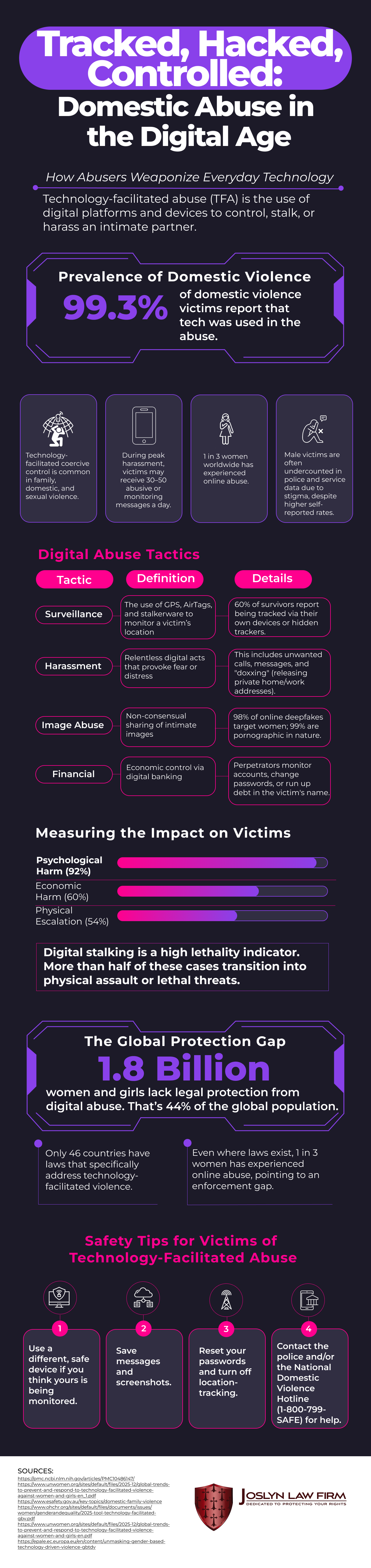
Research has shown that 99.3% of domestic violence victims report that technology was used in the abuse. This reflects a shift toward forms of control that are constant, remote, and difficult to escape.
During peak periods of harassment, victims may receive 30 to 50 abusive or monitoring messages per day, reinforcing a sense of surveillance and limiting their ability to disengage.
Globally, one in three women has experienced online abuse, though male victims are often undercounted in official data due to stigma despite higher rates in some self-reported studies.
Technology-Facilitated Abuse Often Overlaps With Criminal Allegations
Technology-facilitated abuse is not limited to unwanted messages or online harassment. In many situations, these behaviors may overlap with criminal allegations involving stalking, intimidation, unlawful surveillance, identity theft, or violations of protective orders.
As digital communication becomes more integrated into everyday life, investigators increasingly encounter cases where electronic activity becomes central to domestic violence investigations and related criminal allegations.
Technology-facilitated abuse may involve conduct such as:
- Monitoring another person’s location through GPS tracking, hidden devices, or shared accounts
- Accessing private accounts, messages, or cloud storage without authorization
- Sending repeated threats, intimidating communications, or persistent unwanted contact
- Sharing intimate images or personal information without consent
- Using financial accounts, passwords, or connected devices to exert control over another person
In many investigations, digital evidence such as text messages, screenshots, app records, and electronic communications may later become important in determining how an incident unfolded. Because these cases often involve evolving technology and complex personal relationships, allegations involving digital abuse can quickly become legally complicated.
Digital Abuse Tactics
Technology-facilitated abuse typically falls into four main categories, each involving the misuse of everyday digital tools.
Surveillance
Surveillance involves the use of GPS tracking, Bluetooth-enabled devices, or hidden “stalkerware” to monitor a person’s location and activity.
Sixty percent of survivors report being tracked using their own devices or concealed trackers, making it difficult to move or seek help without being observed.
Harassment
Digital harassment includes repeated, unwanted communication designed to intimidate or overwhelm. This can involve persistent calls, messages, and threats, as well as tactics like doxxing, where private information is shared publicly.
In high-intensity situations, this harassment can become constant, with dozens of messages sent in a single day.
Image Abuse
Image abuse refers to the non-consensual sharing or creation of intimate content.
Online deepfakes target women in 98% of cases, and 99% of those are pornographic, making this a rapidly growing method of exploitation and control.
Financial Abuse
Financial abuse involves the use of digital banking tools to exert economic control. This may include monitoring accounts, restricting access, changing passwords, or accumulating debt in another person’s name.
Because financial systems are increasingly digital, this form of abuse can be both immediate and difficult to detect.
Digital Abuse Can Escalate Beyond Online Harassment
Technology-facilitated abuse is often part of a broader pattern of coercive control rather than isolated online behavior. In many cases, digital harassment overlaps with emotional abuse, financial manipulation, stalking, threats, or physical violence occurring offline.
Because digital communication allows constant access to another person, abusive behavior can continue well beyond face-to-face interactions. Victims may feel unable to disconnect from the abuse, particularly when monitoring, threats, or repeated contact occur across multiple devices and platforms.
Digital abuse may escalate through conduct such as:
- Repeated monitoring of a person’s location, communications, or online activity
- Threats involving private images, financial accounts, or personal information
- Persistent harassment through text messages, social media, email, or connected apps
- Attempts to isolate victims from family, friends, or support systems
- Escalation from online intimidation into in-person stalking, threats, or violence
Research has shown that technology-facilitated abuse can become a significant warning sign in high-risk domestic violence situations. In many cases, patterns of digital monitoring, intimidation, or coercive control may intensify over time, particularly when an individual attempts to leave a relationship or seek outside help.
Measuring the Impact of Digital Domestic Abuse
The effects of technology-facilitated abuse extend beyond digital spaces and often overlap with other forms of harm. Survey data shows that many victims experience multiple impacts at once:
- Psychological Harm: 92% of victims
- Economic Harm: 60% of victims
- Physical Escalation: 54% of cases
Digital stalking is considered a high risk indicator. More than half of these cases escalate into physical violence or credible threats, underscoring the seriousness of early warning signs.
Laws Addressing Technology-Facilitated Abuse Continue to Evolve
As technology-facilitated abuse becomes more common, lawmakers and law enforcement agencies continue struggling to keep pace with how quickly digital platforms, communication tools, and monitoring technology evolve. In many jurisdictions, existing criminal statutes were not originally designed to address forms of abuse involving online harassment, cyberstalking, account intrusion, GPS tracking, or digitally facilitated coercive control.
Although some states have expanded laws addressing cyber harassment, stalking, non-consensual image sharing, and electronic surveillance, legal protections remain inconsistent across jurisdictions. Conduct that may lead to criminal charges in one state may be handled differently in another depending on how local laws define electronic harassment, unlawful monitoring, or digital intimidation.
Investigations involving technology-facilitated abuse may also become complicated because:
- Digital evidence can be deleted, altered, or distributed across multiple platforms
- Electronic records may involve data stored by third-party apps, cloud services, or social media companies
- Jurisdictional issues can arise when conduct crosses state lines or involves anonymous online activity
- Law enforcement agencies may face limitations in accessing encrypted communications or account data
- Rapidly changing technology can outpace existing investigative procedures and legal frameworks
Even where legal protections exist, enforcement challenges often remain significant. As technology continues evolving, courts, lawmakers, and investigators continue addressing how digital abuse should be identified, investigated, and prosecuted under existing criminal and civil laws.
The Global Protection Gap
Despite the prevalence of digital abuse, legal protections remain limited.
An estimated 1.8 billion women and girls—44% of the global population—lack legal protection from technology-facilitated abuse. At present, only 46 countries have laws that specifically address this form of violence.
Even where laws exist, enforcement gaps remain significant, highlighting the disconnect between legislation and real-world outcomes.
What to Do if You Suspect Digital Abuse
If you believe your devices or accounts are being monitored, taking the wrong step can alert the abuser. It’s important to act carefully and prioritize your safety.
- Use a Safe Device: Access help from someone else’s phone or a public computer if your own device may be monitored.
- Save Evidence: Keep messages, call logs, and screenshots — do not delete them.
- Secure Your Accounts: Reset passwords and review account access using a safe device.
- Turn Off Tracking: Check and disable location-sharing settings where possible.
- Get Help: Contact police and/or the National Domestic Violence Hotline (1-800-799-SAFE) if you are in danger
Digital Evidence Can Become Central in Criminal Investigations
In cases involving technology-facilitated abuse, digital evidence often becomes one of the most important parts of a criminal investigation. Text messages, emails, social media activity, GPS data, account records, screenshots, and app communications may all be reviewed by investigators when evaluating allegations involving harassment, stalking, threats, or coercive control.
Because so much communication now occurs electronically, even routine digital activity can later become relevant during an investigation or court proceeding. In some situations, investigators may attempt to reconstruct timelines, analyze device activity, review deleted communications, or examine how individuals interacted across multiple digital platforms.
Digital evidence involved in criminal investigations may include:
- Text messages, direct messages, emails, and call logs
- GPS records, location-sharing data, and connected-device activity
- Social media posts, screenshots, photographs, or cloud-stored files
- Account-access records, password changes, and login histories
- Metadata, app activity, and electronically stored communications collected from digital devices
Because digital evidence can be easily altered, deleted, or misinterpreted without proper context, investigators, prosecutors, and defense attorneys often closely examine how electronic records were obtained, preserved, and interpreted during an investigation. In many cases, the surrounding context of digital communications may become just as important as the content itself when allegations are reviewed in court.
Why Legal Representation Matters
Technology-facilitated abuse can overlap with serious criminal allegations, including threats, harassment, stalking, and financial control. In some cases, these situations may lead to charges such as domestic violence, drug crimes, or gun and weapon offenses, depending on how the facts are interpreted by law enforcement.
When criminal charges are involved, the details matter. Evidence, digital communications, and context can all influence how a case is charged and prosecuted. If you are facing allegations or believe you may be under investigation, it is important to understand your rights and options early. The Joslyn Law Firm works as Ohio domestic abuse lawyers as well as providing defense representation across a wide range of criminal matters in Dayton, OH, and across the state. Contact us today.
Sources:
- https://pmc.ncbi.nlm.nih.gov/articles/PMC10486147/
- https://www.esafety.gov.au/key-topics/domestic-family-violence
- https://www.ohchr.org/sites/default/files/documents/issues/women/genderandequality/2025-tool-technology-facilitated-gbv.pdf
- https://www.unwomen.org/sites/default/files/2025-12/global-trends-to-prevent-and-respond-to-technology-facilitated-violence-against-women-and-girls-en.pdf
- https://epale.ec.europa.eu/en/content/unmasking-gender-based-technology-driven-violence-gbtdv
- https://www.stalkingawareness.org/wp-content/uploads/2024/03/Technology-Facilitated-Stalking-SLII-Behaviors.pdf
- https://www.techsafety.org/resources/
- https://www.techsafety.org/documentationtips
- https://www.justice.gov/ovw/stalking
This page was last updated by Brian Joslyn