


Age of Consent by State (2026): Every U.S. State Mapped
Two people can cross a state border without changing their ages, their relationship, or their intentions. What can change is the law.
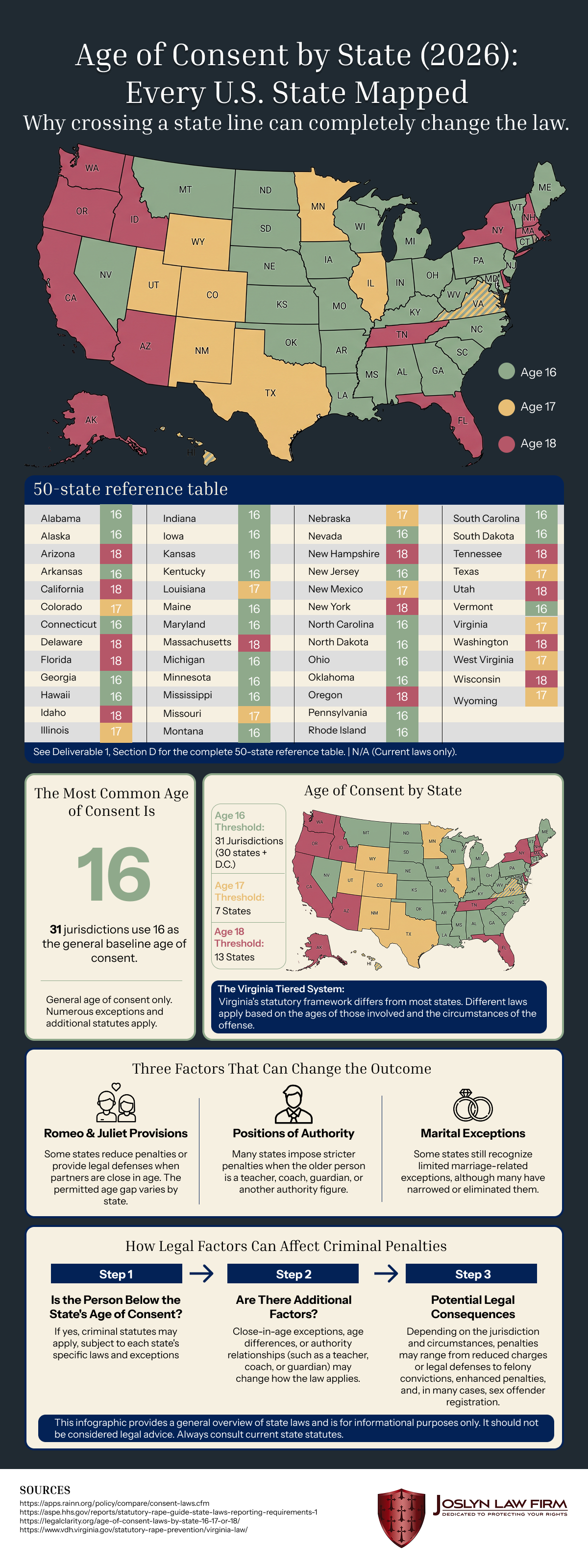
The United States has no single nationwide age-of-consent rule. Each state and the District of Columbia sets its own baseline age, exemptions, defenses, and penalties. In some places, the general age is 16. In others, it is 17 or 18.
But those baseline ages tell only part of the story. Age differences, close-in-age protections, marriage, and positions of authority can all change the legal outcome.
Click to view the full-size infographic
What Is the Age of Consent?
The age of consent is the age at which a person is generally considered legally able to agree to sexual activity. When someone is younger than that age, state law may treat them as unable to give legal consent.
“Statutory rape” is a common umbrella term, but state criminal codes use different names, including sexual assault, unlawful sexual conduct, sexual abuse, or carnal knowledge.
The law may depend on more than age alone. The relevant statute may also account for the age difference, the type of conduct, whether one person holds authority over the other, and whether an exemption or defense applies.
For that reason, a state’s general age of consent is best understood as the first question, not the final answer.
State Law and Federal Law Can Both Apply
General age-of-consent laws are set mainly through state criminal codes, not one nationwide rule. Federal law may still apply in cases involving interstate travel, trafficking, federal property, exploitation, or sexually explicit images involving anyone younger than 18.
The Most Common Age of Consent Is 16
The map groups 30 states and the District of Columbia under age 16, seven states under age 17, and 13 states under age 18. Virginia is included in the age-18 count but is visually distinguished because its laws use a more complex tiered structure.
The complete state-by-state breakdown appears in the infographic. These categories describe the general baseline only. A state may apply different rules when the people are close in age, one person holds a position of authority, or another criminal statute applies.
Why Virginia Is Treated Separately
Virginia is visually distinguished within the age-18 group because different statutes and thresholds apply depending on the ages and circumstances involved.
That tiered structure illustrates a broader problem with national comparisons: one number can hide several overlapping rules. The map therefore marks Virginia differently rather than forcing it into a category that could be misleading.
Three Factors That Can Change How the Law Applies
The same baseline age can produce very different legal outcomes. What often changes the result is not the number on the map, but the relationship between the people involved.
Close-in-Age or “Romeo and Juliet” Provisions
Close-in-age laws are intended to distinguish peer relationships from cases involving a much older person. Depending on the state, they may prevent prosecution, provide a defense, or reduce the severity of a charge.
There is no national standard. One state may permit a two-year gap, another may allow a wider gap, and another may provide no comparable protection at all.
A state may treat a relationship between two teenagers differently from one involving a young teenager and a much older person, even when the younger person is below the general age of consent.
Federal research shows that states combine the younger person’s age, the older person’s age, and the gap between them in different ways. These variations show why knowing the younger person’s age alone is often not enough to determine how the law applies.
Positions of Trust or Authority
Many states apply stricter rules when the older person holds authority over the younger person, including teachers, coaches, guardians, counselors, and other supervising adults.
These laws address the power imbalance that can exist when one person supervises, teaches, cares for, or otherwise holds authority over the other. A person who is above the state’s general age of consent may still be legally protected from sexual conduct with an adult who has authority over them.
The exact roles and age limits vary. In Mississippi, for example, RAINN’s statutory summary identifies an age of consent of 18 when the other person is in a position of trust or authority. Michigan similarly applies separate protections involving people employed by the younger person’s school.
Marriage-Related Exceptions
Some state criminal codes historically recognized marriage as an exemption or defense to particular sexual offenses involving minors. These rules are separate from laws governing the minimum age at which a person may marry.
Marriage-related rules vary widely. In some states, marriage may affect whether a particular offense applies, while other states have narrowed or removed earlier exemptions. Because marriage and age-of-consent laws operate separately, a valid marriage does not automatically resolve every criminal-law question.
Why the Same Ages Can Lead to Different Outcomes
Imagine two people with the same age difference in two neighboring states. In one state, a close-in-age provision may apply. In the other, the same relationship may fall within a criminal statute.
The outcome can change again when one person is a teacher, coach, guardian, or another authority figure. The type of conduct, the exact ages, and the state where it occurred may all determine whether the law provides a defense, a reduced charge, or a felony penalty.
That is why an age difference alone cannot determine how the law applies. The full legal context matters.
Is Statutory Rape the Same as Sexual Assault?
Statutory rape and sexual assault can overlap, but they are not always the same offense.
Statutory offenses are based primarily on age. Physical force does not have to be alleged for the law to apply. Sexual assault is a broader category that may involve force, threats, coercion, incapacity, or lack of consent at any age.
Because states use different names and definitions, the exact charge depends on the jurisdiction and the facts.
A case involving a minor may also fall under more than one statute. When force or coercion is alleged, prosecutors may pursue offenses that are separate from or more serious than an age-based charge.
Why State Borders Can Complicate a Case
A state border can change the answer, but not always in a simple way.
The relevant law may depend on where the conduct occurred, where the people traveled, where communications took place, and whether federal law is involved. That means a case connected to more than one state can raise questions that a national map cannot resolve on its own.
Digital activity is governed by different rules. Federal and state laws generally prohibit the production, possession, or distribution of sexually explicit images involving anyone younger than 18, regardless of the state’s general age of consent.
In other words, age-of-consent laws do not determine whether an image is legal.
A Map Is a Starting Point, Not Legal Advice
The map reveals where the major differences begin, but it cannot resolve an individual case. Two states with the same baseline age may still have different rules for close-in-age relationships, authority figures, marriage, felony classifications, and registration.
The clearest lesson is not that one age is “right” and another is “wrong.” It is that U.S. law treats age, relationships, and authority differently from one state to the next.
For parents, educators, and young people, understanding those differences can help prevent mistaken assumptions about which rules apply. Anyone dealing with a specific situation should verify the current statutes and consult a licensed attorney in the relevant jurisdiction.